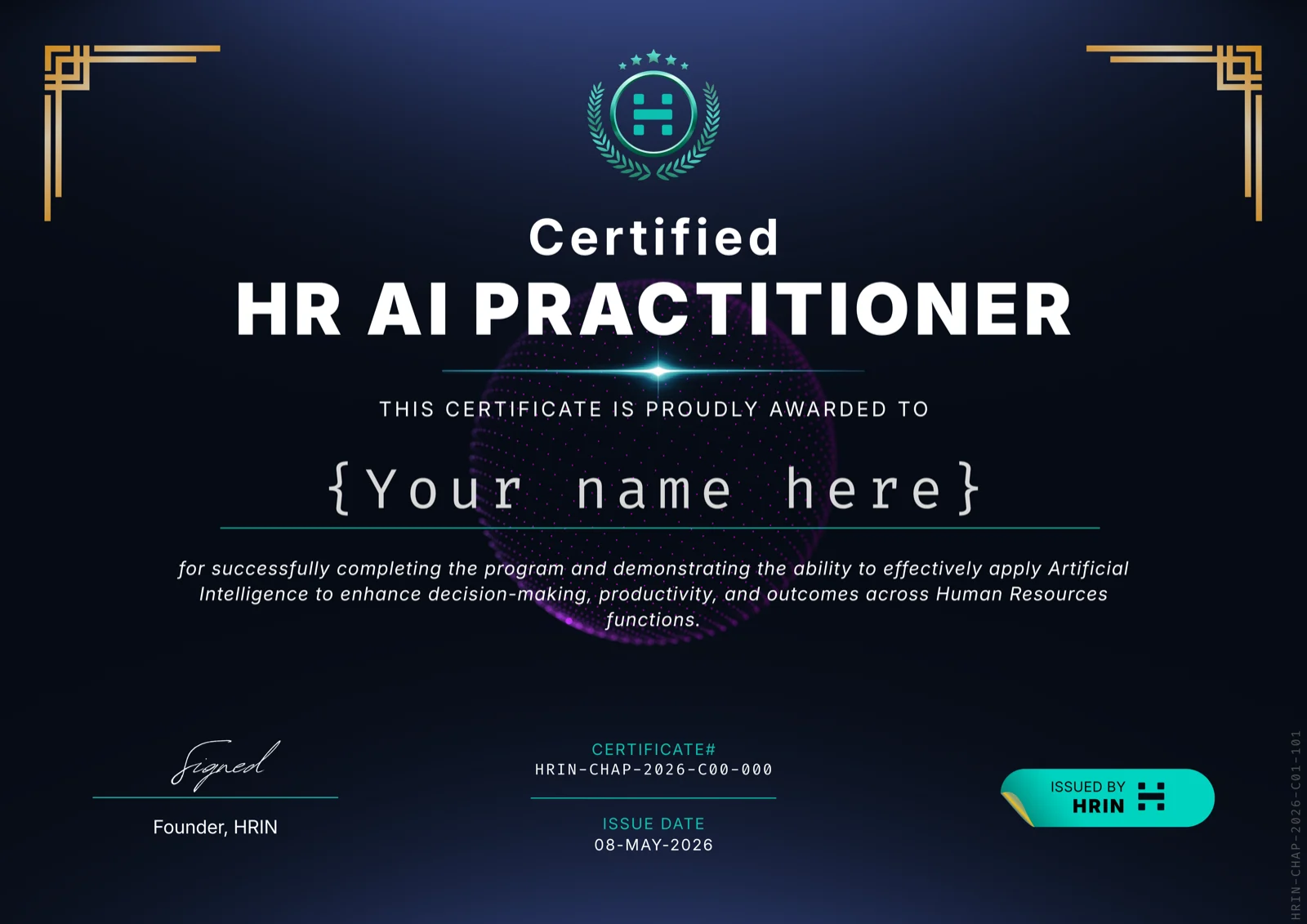






The HR profession is dividing into two groups. Those who know how to work with AI and those who are watching others do it. This program puts you firmly in the first group, with a credential to prove it.
We review every registration and confirm your spot personally.
You pasted a question and got a five-paragraph response written for nobody in particular. That is a prompting problem, not an AI problem. This program fixes that with practical technique, not theory.
Exit surveys, pulse results, attrition records. You know there are insights in there. Session 3 turns that data into something leadership will act on, without a data science background.
Not a badge for watching videos. A certification backed by a live project, evaluated by a panel of senior HR leaders. Something you can speak to confidently in any professional conversation.
No prior AI or technology background needed. Two years in any HR role and the willingness to open your laptop and try.
Policies, people matters, hiring, data requests. AI reduces the administrative load and sharpens what you produce.
Job descriptions, resume screening, candidate communication. Three areas where AI creates immediate, measurable impact.
Months of data that rarely makes it into a leadership decision. Session 3 turns that data into boardroom-ready dashboards.
Each session is a 90-minute live workshop. Click any session to see what happens inside.
How AI works and why your prompts produce what they produce. Choosing between ChatGPT, Claude, and Gemini based on the task. The five-part prompt framework built and tested in session. The most common HR prompting mistakes, seen live with the bad outputs they create. Using follow-up prompts to refine, push back, and get exactly what you need.
Why most JDs fail before anyone applies and how to spot it in your own. A five-dimension framework for auditing any job description. Running a live AI audit on a real JD, rewriting it, and comparing before and after. Building a consistent resume screening framework. Simulating ATS scoring logic on a real resume, improving it, and watching the score change. Running a bias audit on all hiring documents produced.
Why HR data rarely makes it into a leadership decision and what to do about it. A single data prep prompt that cleans and frames your raw Excel for AI analysis. Interrogating your dataset in plain English and getting structured answers with reasoning shown. Building an executive dashboard from your outputs. Feeding exit interview responses and pulse verbatims into AI and getting back themes, quotes, and a recommended action. Writing the one-paragraph leadership narrative that gets your work read.
Why AI is confidently wrong and how to catch it before it costs you. Red-teaming your own prompts by asking AI to argue against its own output. Using AI to prepare for difficult HR conversations: performance exits, restructuring, contested grievances. Building your personal AI protocol: when you will use AI, when you will not, and the verification step between AI output and professional action. Full capstone briefing with all six tracks, rubric, and Q&A.
After session 4, participants pick one of six capstone tracks and ship a complete AI workflow. Reviewed against a published rubric. The HRIN CHAP L1 Certificate is issued only on a passing capstone.
Grouped into teams, you choose one of six project tracks and build a complete AI-assisted HR solution. You present it live. An external panel of senior HR leaders evaluates it.
Build an AI-powered onboarding journey for one specific role covering the first 30, 60, and 90 days. You produce AI-generated documents for at least three onboarding stages and a reusable prompt set that any HR professional can use for a different role. The live demo requires you to generate onboarding content for a role the panel names on the spot.
Pick one specific people question your organisation needs answered. Build an AI-generated analysis from a real or realistic dataset, structure it into an executive-ready dashboard with three to five key metrics, and write the one-paragraph leadership narrative that says what it means and what to do. The panel asks one data question live and you answer it using AI in real time.
Build a complete AI-assisted hiring toolkit for one job family that another recruiter could pick up and use without any guidance from you. Includes a fully audited and rewritten JD, a screening framework, an ATS scoring prompt, a candidate communication set for every stage, and a bias audit report. The panel names a role variation and you generate one document from the toolkit live.
Take three real HR communications, redesign each using AI, and show the before and after with written annotation on every significant change. At least one must be a difficult communication. You also submit a reflection on where AI got it right, where it got it wrong, and where human judgment had to step in. The panel gives you a scenario live and you draft and refine it using AI in real time.
Redesign your performance management cycle using AI, identifying exactly where it can and cannot assist at each stage. Build at least two working AI tools a manager can use independently, such as a goal quality checker or a feedback reviewer, and write a one-page plain English guide for someone who has never used AI. The panel provides a goal or feedback sample live and you run it through your tool in real time.
Build an AI system that answers employee questions about five real HR policies accurately and in plain language. You submit a testing report covering 10 questions asked, how accurate the answers were, and what you changed. The prompt architecture must be documented clearly enough for another HR professional to maintain it. The panel asks three questions to your system live and evaluates the answers on the spot.
Presentations are reviewed by an invited panel of senior HR practitioners and technology leaders. Panel profiles shared before the final session. Written feedback delivered to every team within five working days.
An honest project on a real HR challenge with clear prompting logic will pass. A polished project built on a fabricated scenario will not.
Is this grounded in real HR work? Does the solution address a genuine challenge, not a generic or fabricated one?
Are the prompts well-structured and reusable? Could another HR professional apply them independently?
Did the team think critically about the AI output? Where did they push back, refine, or reject what was produced?
Is the presentation clear and confident? Would a CHRO understand and act on this in eight minutes?
Evaluated, evidenced, and issued by the only HR-exclusive professional community in the world. Something you can speak to in any room.
HRIN members receive preferential pricing. Non-members are welcome to apply at the standard rate.